

What might read as a bit of a funky, almost esoteric-looking title is going to make sense in about a moment or two.
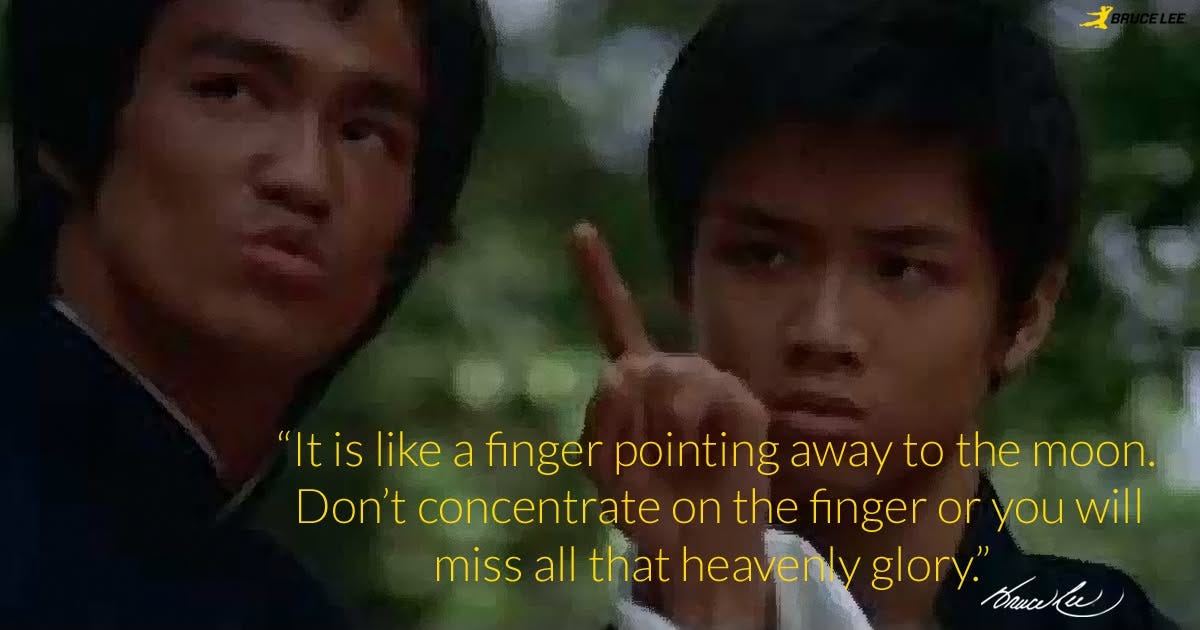
I recently shared a note on how I believe that the conversation around Africa and development has been hacked, and hijacked by symbols (among other things!). Without lunging too deep into the abstract, let’s begin with my own symbol in an iconic quote:
What are symbols and symbolism?
Symbols are projections, representations that are accessory to something else typically preceding and encompassing said symbol. When kung-fu G.O.A.T Bruce Lee points to the Moon the eyes of his young Padawan settle on his finger. The stare of the young man is wayward, struggling to find focus, he fixes his view on what is nearest and dearest to him. For that split moment his mind became entangled with the secondary, show over substance, the ripple instead of the stone.
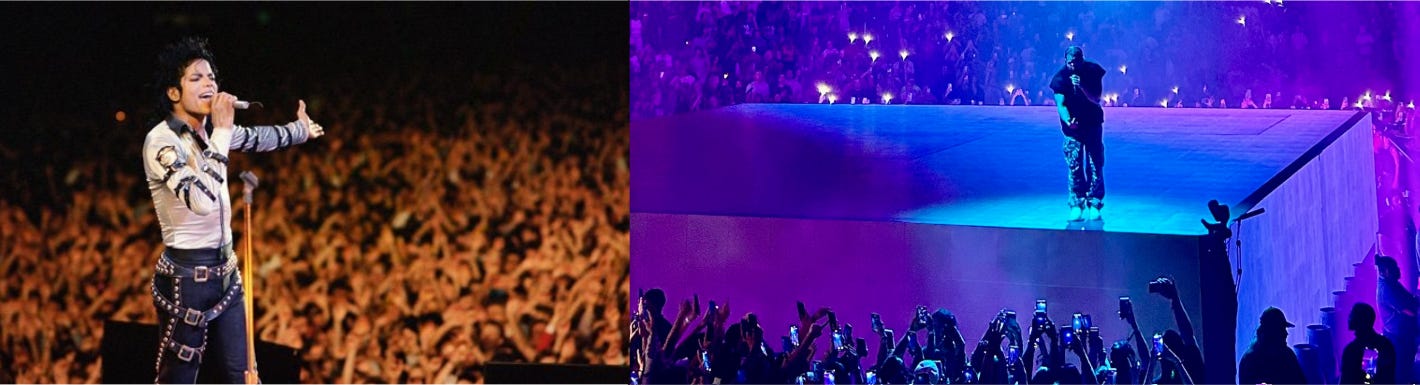
Being there for the moment is not the same as being in the moment. In a world where we struggle to be present we need to remind ourselves that the finger pales in the face of the Moon and is ultimately, besides the point.
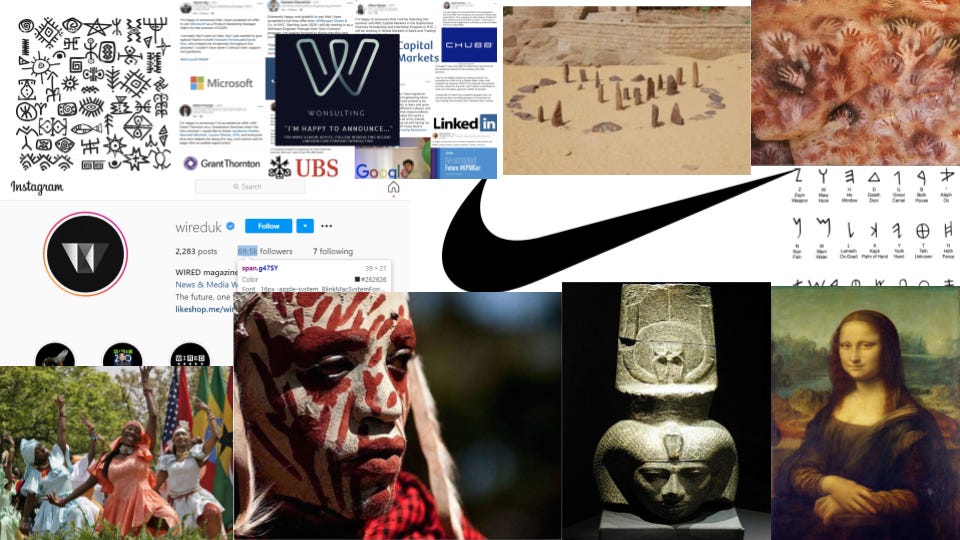
Symbols channel and project meaning. Such symbols are the products of our brains and bodies. Through symbols anchored in sight, signs, animation and sound, we are capable of negotiating with the universe to help shape our reality and our state of being.
Words and letters, characters, numbers, wear, video, brands - all symbols concomitant to underlying meaning. Their existence and utilization employed for a broader purpose, all human creations that appear and transform reality. In saying all of this it’s important to remember how symbols and symbolism are agents of representation expressing their take of reality. They are not the end in and of itself.
Furthermore, because symbols are human creations they are vulnerable to manipulation that can be leveraged into control over others.
The modern world is drowning in symbols and echoes
And society today has been co-opted by social media, the mainstream media and ultimately, multimedia. It’s why so much of what we consume in life today, be that our food, clothing, personal belongings, hobbies, our identity, is knowingly or unknowingly tied to at least one or more of the modern Media Trio.
Yet no matter how sophisticated and enchanting the symbols may be, the representation is not the equivalent of the represented. The most regal and sturdy looking cart still doesn’t come before the horse.
Existence has become so symbolic as to drown out our natural senses and present us with mirages, mirages that we’re beginning to believe in and motion towards, leading us astray from our true path.

The cart and the horse, the representation and the represented, symbolic representation set off against objective truth and true intent. Journalism and reporting, expert analysis and opinion, and even the halls of academia in some instances is rooted in the sharing and discussing of symbolic content. The media and the entertainment industry across the board fight for dwindling attention spans and multiplying screens, amidst the backdrop of a changing business model.
The fight for eyes incentivizes income-earning content creators to manipulate symbols that tug at our emotions, peddle in our vices, and cater in conveniences. The outcome being that millions take medical advice from unqualified YouTubers, and world leaders are still able to justify war and the slaughter of the innocent on the grounds of divine intervention in the 21st Century. While the primary source we rely on for accessing and interacting with information and content is essentially the internet.
Through the introduction of the creator-platform ad partnership model along with the inclusion of metrics that filter for social clout, players in Big Tech seem intent on monetizing anything and everything that is content.
How long it will it be before you set-up a YouTube channel for that new hobby of yours?
It’s no wonder why so much of what we’re exposed to online via Google’s search results, social media, and YouTube (which is TV to a lot of us within the younger demographics) comes across as hollow. Perhaps framing the case for Dead Internet Theory in a new light.
Let me further illustrate my thoughts with a short case study of sorts.
Show me the photo-op
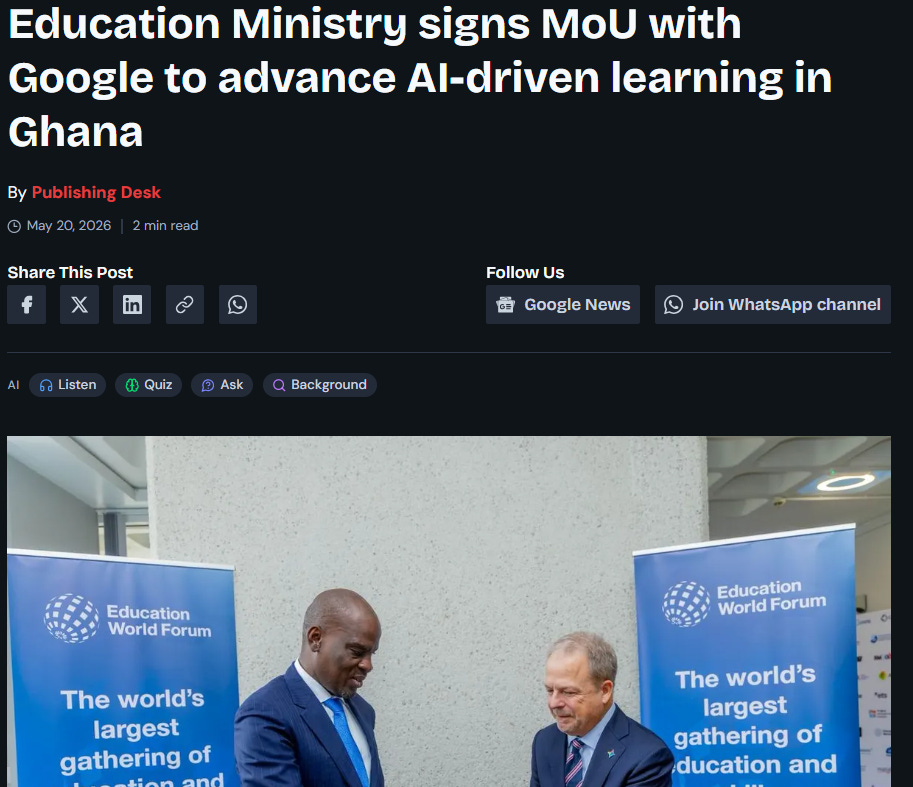
Here we see a recent headline coming out of Ghana announcing the signing (there’s already a clue) of a Memorandum of Understanding or MoU between the country’s Ministry of Education and Google, specifically Google for Education.
It’s a short post with the most tangible section of it informing us on how:
“The partnership is expected to strengthen digital literacy, build the capacity of teachers, promote innovation in classrooms, and equip Ghanaian students with critical 21st-century skills needed to thrive in an increasingly technology driven global economy.”
Okay cool, but what does that actually mean?
The quoted statement is riddled in symbols, packed with buzzwords such as digital literacy, innovation, and 21st-century skills. It’s almost as if the author is rambling on for the word minimum, throwing in popular keywords as a tribute to the search indexing lords. It’s also highly likely that the author is generative AI.
If you read the article as someone who isn’t familiar with the world of AI you would have finished it having very little idea of what exactly is going on and how the tech in question factors into it all.
The publishers could have hyperlinked Google for Education to the actual AI platform, but they didn’t. They made mention of none of several of Google for Education’s products, ranging from Gemini for Education, NotebookLM, and Google AI Pro for Education either. Google for Education’s official YouTube channel literally has thousands of videos that explore the platform in more detail, yet not a single one of their videos has been embedded into the post.
I believe additions along these lines would do a better job in telling readers how the partnership between the Ghanaian government and Google for Education might deploy AI tech to raise literacy rates for students in rural villages and towns, identify learner strengths and weaknesses, or improve and streamline the processes behind the provision of student-teacher feedback.
We wanted them to tell us what it is, but instead, they told us what it might be.
Meat that we can sink our teeth into and build with. Instead you’re left with a lot of window dressing, aspirational claims, and grand promises. You might not learn any more on AI in Africa after reading that post, but you will probably be able to recall details like the names of the people and organizations party to the agreement and what country the MoU (whatever that really is) was signed in. And perhaps that is the goal of the article..
What at first sight nowadays reads as your run-off-the-mill press release piece, descends into a dry text of shallow verbiage. By trying to appease every stakeholder, it clarifies nothing: it is sanitized, safe, and corporate. Symbolism makes it possible for you to create a model drawing of a product stunning enough to sideline any questions people might have had concerning its technical feasibility.
The politicians and the executives come out of it looking busy and better-off - we got the photo-op but we never got the chance to examine the foundational blueprint under a microscope. It’s vital that we do; structural change is typically evolutionary in its scale and complexity. It’s much like the invisible transmission of a pathogen across a population, all happening off-camera, and in this case is hidden deep within the fine print of institutional networks and norms.
Thus, I look at that story and scratch my head and immediately begin to wonder about what is actually going on. To paraphrase (without endorsing) a now infamous rap record executive who is currently rotting away in a cell somewhere in New Jersey: we wanted them to tell us what it is, but instead, they told us what it might be.
Symbols carry the capacity to unite people and resources around a common interest. When effectively communicated, symbols enable humans to wield extraordinary heights of will and control over the world we’re in. Whether they’re in the form of slogans, appeals to authority, the use of analogy and idiomatic expressions to get a separate point across, memes, music, ritual and performance, symbols compress and pinpoint meaning and messaging.
In the next instalment of this post series we will be learn about the first of the four entitled figures in Plato, the Middle Child of the Greek Three. His works revolutionized the world of symbolic communication through the introduction of writing as thought. In the process, the power of the symbol became a double-edged sword - sharpened with the ability to electrify and liberate the spirit, or pacify and control it.
“I make music that electrify 'em, you make music that pacify 'em.” Kendrick Lamar | Euphoria
The following works contain frameworks and excerpts from a book that is in the works. If you like these kind of breakdowns and scientifically-framed analyses then please subscribe so you can be among the first to get updates on my journey to writing my book.